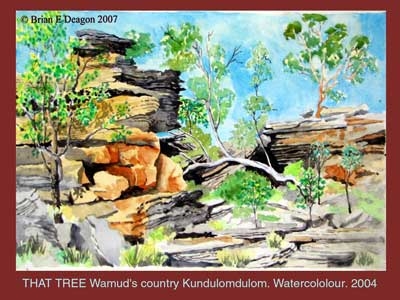
Painted a watercolour of Bardayal's boyhood home country. I had to get permission to go there. When I showed him the painting he said it was "Good but where that tree? You put in that tree!" I had left out the fallen tree which is now the focal point, but it was qiute clear he knew every rock and tree as a unique entity. The second version got the thumbs up.
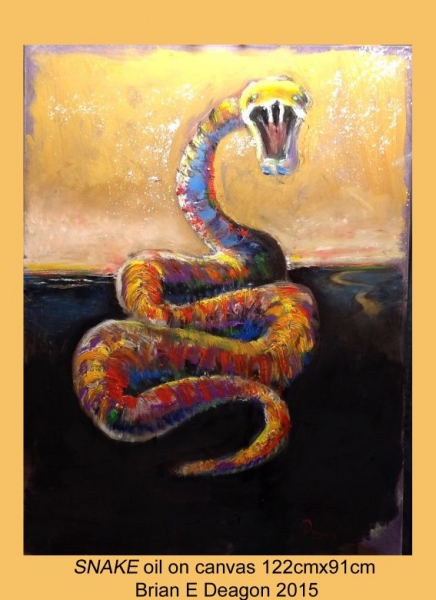
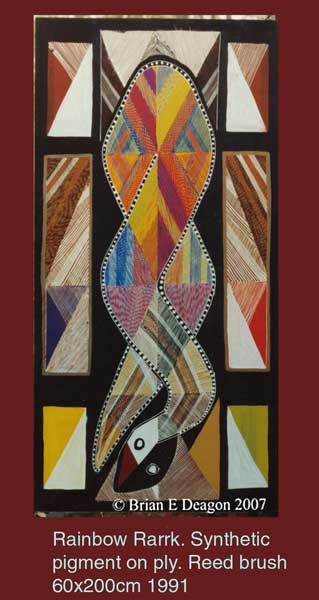
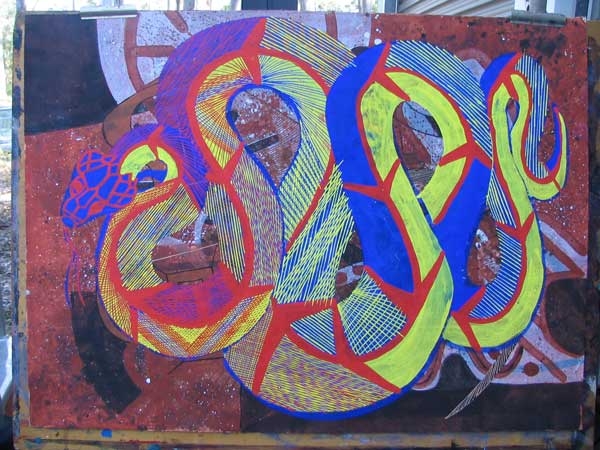
He has divided light and darkness, sky and land,and begins moving across the landscape creating rivers and waters. the horizon partakes of all his colours. Snake is an elemental force and needed to be painted with a process as elemental. He is painted with pieces of rag
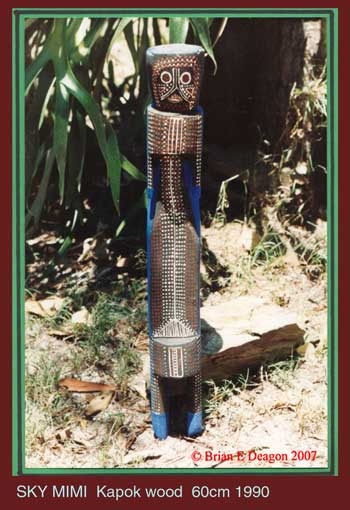
Caruso Gurdal showed me how to make a Mimi.Its all cut from the kapok tree while green. Filing and sanding( using leaves from the sandpaper tree) is done when dry.Grass was cut sharp to do the dots. He is half coloured because he lives in the rocks, but mine lives in the sky. When I asked Caruso if mimis had bones, he exclaimed "I got bone!"Mimi have teeth."Some good-some bad" In decorating my Mimi a crowd was slowly gathering,and getting quite animated. Marwundjul saved me by announcing "Accident" I still have no idea what that was all about.
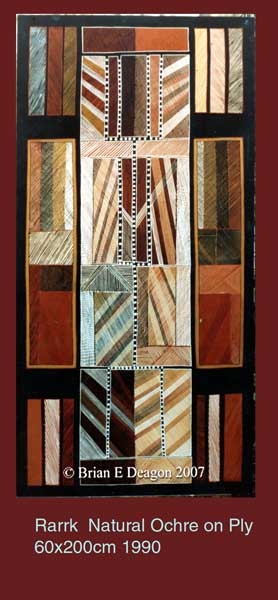
A systematic exploration of the possibilities of rarrk. Its optically infinite, And meant to be seen on black bodies by firelight, where the design literally becomes "disembodied" Aborigines concieve the design before they begin" think about him...think about him" Visual vibrancy is part of the aesthetic, which is why ochers with the sparkle of haematite were so valued.
What would happen if I replaced ochres with synthetic pigments? Op art of course!
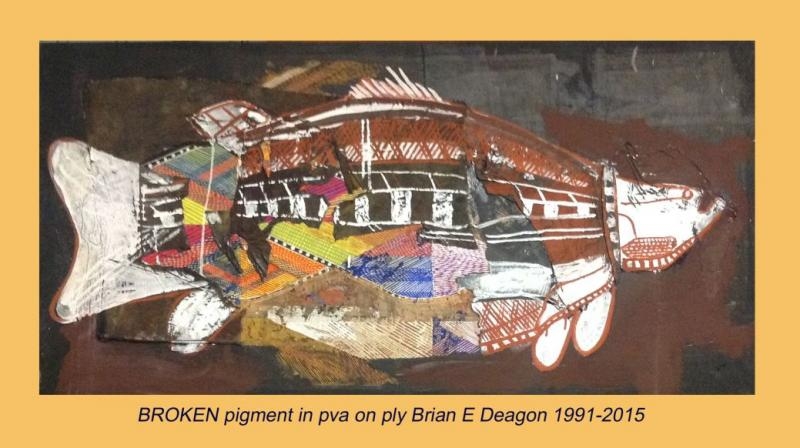
A fragmented barra symbolises a fragmented culture. this fish has revealed the rainbow at its core
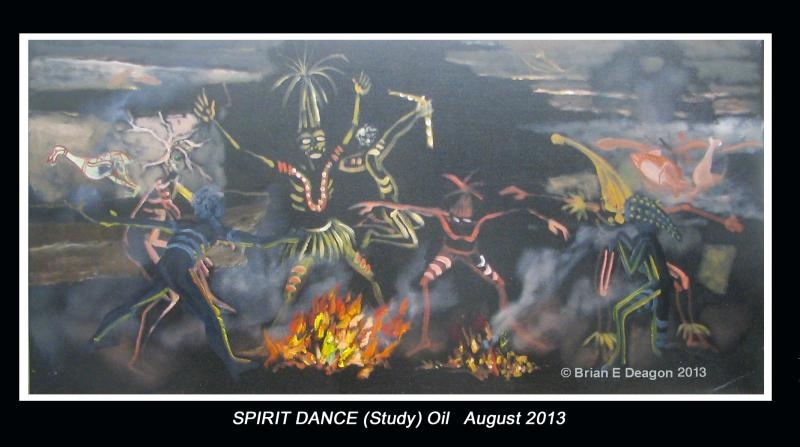
A Foucault silence. What is absent from my landscapes is the people. Terra Nullius. So maybe the spirits can dance. Paint the body paint, not the body.
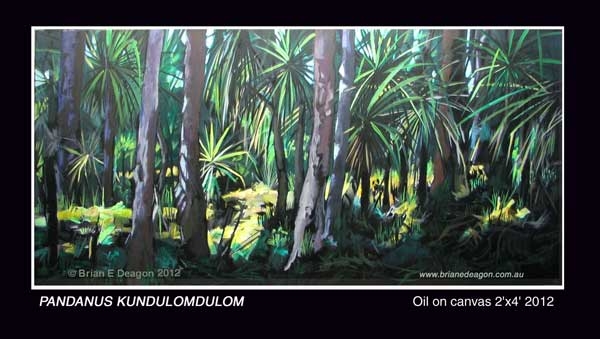
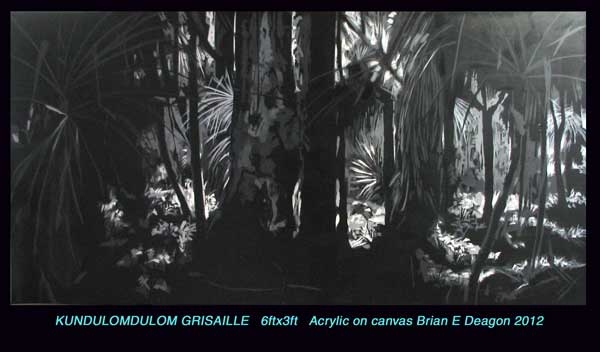
The road from Kupulwarnamyo to Wamud's boyhood country. Its basically glazes over an acrylic undercoat in seven tones, beginning with a black imprimatura then working the grisaille in successively lighter tones. Archivally I feel this procedure is sound, and allows the "brights" to be still laid in first.
On the road to Kupulwarnamyo this watercourse. It has taken 6 years to develop the skills to paint it. essentially its tonal calligraphy. Everyone pleads with me not to colour it.
Unfinished. The silhouette of the snake lacked power at every attempt. Now I lack the serenity to complete the rarrk. I am balanda.
In an interview , Marwundjul relates how he saw rarrk in the sparkling ripples of the water when fish disturbed the surface. There is deep significance to this. Although he and others said it was ok for me to paint "aboriginal way" I have always felt uncomfortable. Till now, because I have seen my own. This "sparkle" or vivacity is treasured in all sorts of situations. Rarrk is a way of extending the visual limits of tetrachrome. It will be noted here that the potential greens,purples and orange dont seem to have fallen into culturally significant use till the advent of acrylic and "me myself" painting.
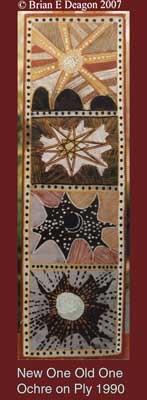
So, having been taught how to grind my ochres, where to find them, how to make a brush from reeds, it's time to paint....what? Anthills. No up or down since barks can be viewed lying flat on the ground. The sun and moon. New one, old one. Rebirth. 20x50cm. I'm keeping this one. It reminds me of a link to people and country that is very strong. I never expected that, but it is a common experience for visitors. Who wants to leave paradise?
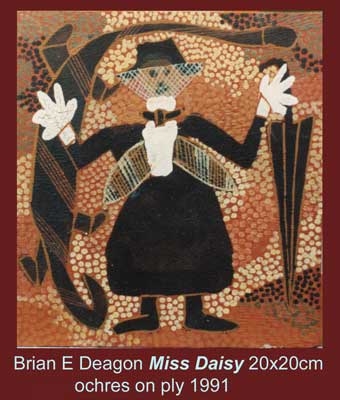
Daisy Bates was an English reporter who took it upon herself to care for the "disappearing race" of aborigines. Reading her stuff, it's never quite clear who was looking after who. I am not finished with this woman. I have a series of some 50 or so paintings planned. They wont use an aboriginal style though. Although I am entitled to, and have permissions, I feel uncomfortable selling work done in that style.
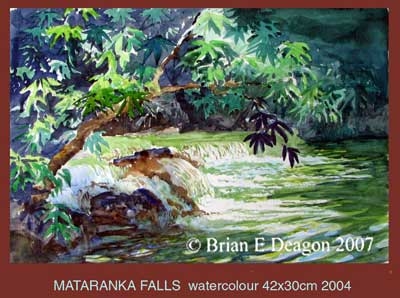
I spent a day at Mataranka falls, doing sketches and finally completing this watercolour. So glad I had purchased a really good wolf hair brush. Saw a huge freshwater croc sunning himself nearby. They have a narrow snout unlike the dangerous saltwater variety. Still, salties dont restrict themselves to salt water. You just have to be careful.
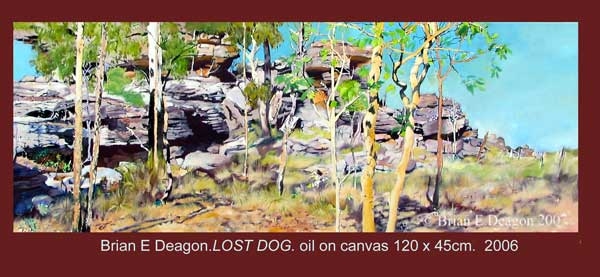
The escarpment country is a labyrinth. You could get lost in a blink. The dog belonged to my sister, and shadowed me all day, just to keep an eye on me. Oh, and take me home if I got lost. You will find him at the lower left behind the tree. No blue in my palette is the colour of that sky. Manganese gives something of the feel of it. It can get to 40 degrees celsius in the shade, and humid to boot!
It is so hard to convey the intensity of the green in these places. The sand is decomposed granite I think. Very pleasant underfoot. You see signs everywhere of the power of the river in its yearly monsoonal flood. This escarpment country is some of the most pristine on Earth.
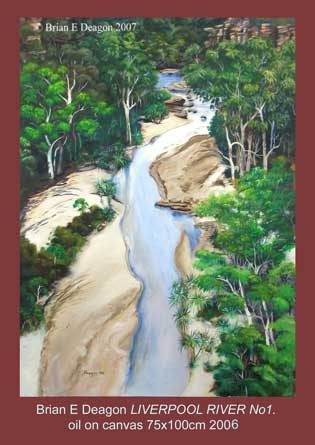
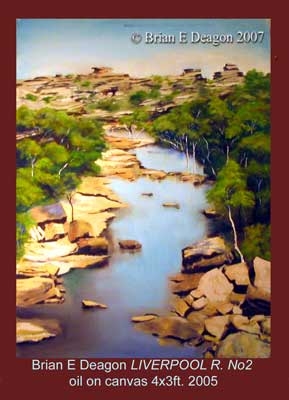
The Liverpool River from a helicopter is an awesome sight. I was immediately entranced by this sky blue running vertically through the canvas.
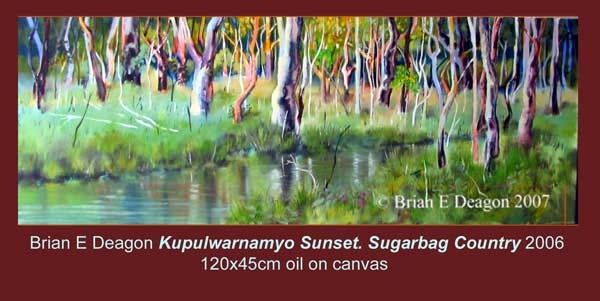
Another side to the Liverpool River which runs through Bardayal's country at Kupulwarnamyo. I caught the afternoon light after rain. The colours were hallucinatory in their intensity. Sugarbag is the name for the honey of the native bee. Unlike the hexagonal shape used by the European bee, the native bee uses a tiny baglike container, hence, "sugarbag".
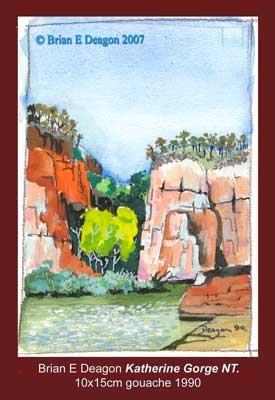
My first visit to the Northern Territory saw me unprepared. So this tiny gouache was the best I could do. Actually I was more interested in working with the artists. Marwundjurl thinks I am "a bit rusty rough one". He showed me so much, and was so patient with my ignorance of their customs.
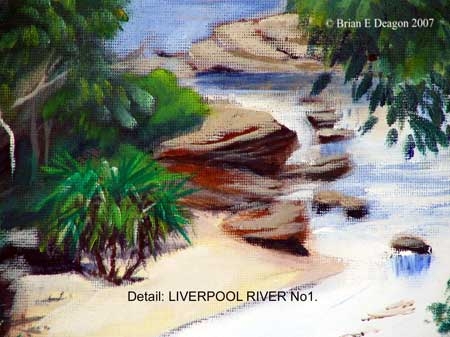
This is a detail from one of the Liverpool R. series. One of the truly difficult things to take in is the lack of human traces, except in the rock overhangs. There, the layers of millenia of artists are so vast they are yet to be cattle dogged.